
| |
|
Frontpage La Floridiana Matt's Rail Movie Review Mike's Rant Viddywell (Terence's site) PCR Archives 2002 2001 2000 Crazed Fanboy homepage PCR 2002 Home |

| Part 4: | |||||||||||||
 | |||||||||||||
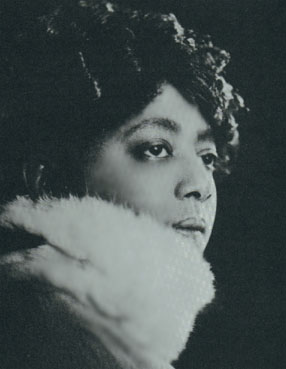
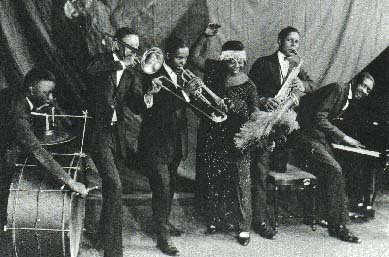
That's the blues as defined by most people today, but in the early 20s before Son House, Charlie Patton and the rest growled out their gritty delta variant, the blues had a different sound and image. In the first half of the 20s, atypical blues artists were women. Usually they dressed in flapper styles and crooned songs of sorrow to jazz accompaniment. In these early days women ruled this new musical form, it wasn't until later that men dominated and all but wiped out the blues women's commercial and artistic impact. The woman's reign in the blues was from about 1923 to 1927. Starting in 1920 with Mamie Smith's recording "Crazy Blues", an achievment considering race records had not yet come into their own at this time. "Crazy Blues" was the first-ever blues recording, making the first blues recording artist a woman.
Bessie usually recorded under optimal studio conditions, but occasionally her recordings are backed by less-than-fair jazz bands who are heard over her voice too well for their own good. Most women blues singers, like Bessie, would cut a fine line between Vaudeville and the blues. But it was Bessie who took the rural blues and fused them with pop sensibilities of the time.
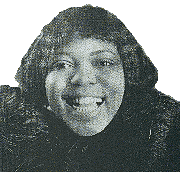
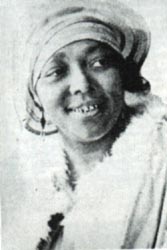
Rainey's blues were also backed by a jazz band like most women blues singers of the time. But unlike Bessie Smith and the rest, Rainey had a deep, throaty voice and was linked closer to the rural south of Charlie Patton than the vaudeville flapper style of the Jazz age. Rainey's records were not as sophisticated, technically speaking, as, say, Bessie Smith's, but her lyrics were far superior, especially on "Bo Weavil Blues", a song about love lost. I got me a hat I brought it back home I laid it on the shelf I looked at my bed I'm gettin' tired of sleeping by myself She recorded her first record in 1923 and recorded all thru the early 20s and 30s until her death in 1939. Her most popular song is "Ma Rainey's Black Bottom". There were numerous women blues singers recording in the 1920s--almost too many to count--most of which are now forgotten. These include: Ida Cox, Sara Martin, and Sippie Wallace. In the mid 30s Bogan moved to Los Angeles and on her first day there was killed in an automobile accident.
By the late 1920s men were taking over the blues market. Few women survived commercially in the 1930s, but some did very well, like the great Memphis Minnie.
Lizzie Douglas, a.k.a., Memphis Minnie was born in Louisiana in 1897. Her family moved to Memphis in 1910 and there, Minnie heard the blues of various local Jug Bands and banjo pickers. From then on she was hooked, and after receiving a guitar for Christmas, she was on her way. By her teens she was performing on street corners for nickels and dimes.
Apparently, Minnie was a hellcat. Any man who tried to fool with her when she didn't want to be fooled with, she would go at them with anything she could find, knife, gun, or broken bottle.
Minnie's guitar playing was excellent and easily stands up to the greats like Son House and Charlie Patton. Memphis Minnie was, without a doubt, the greatest female blues artist of her era and ranks among the best of the blues singers, regardless of gender.
By the late 30s, men were the dominant force in the blues, all but erasing women's place in the genre. But the women blue singers recorded some of the most accessible and earliest of all blues records, which is no small accomplishment. If "Ma" Rainey's claim holds true, it may, in fact, have been a woman, not a man, who first heard and coined the term for this important musical form.
| |||||||||||||
"The Enlightenment" is ©2002 by Terence Nuzum. Webpage design and all graphics herein (except where otherwise noted) are creations of Nolan B. Canova. Contents of Nolan's Pop Culture Review is ©2002 by Nolan B. Canova.